Order-to-Cash Automation: A Buyer's Guide
Evaluate order-to-cash automation stage by stage, with a per-stage checklist, a weighted 100-point scorecard, and the demo questions that expose thin connectors.
Key takeaways
- Evaluate order-to-cash automation stage by stage: order capture, fulfillment, invoicing, collections, cash application, and reporting.
- Automate order capture and fulfillment first; that is where oversells, stale inventory, and exception queues pile up fastest.
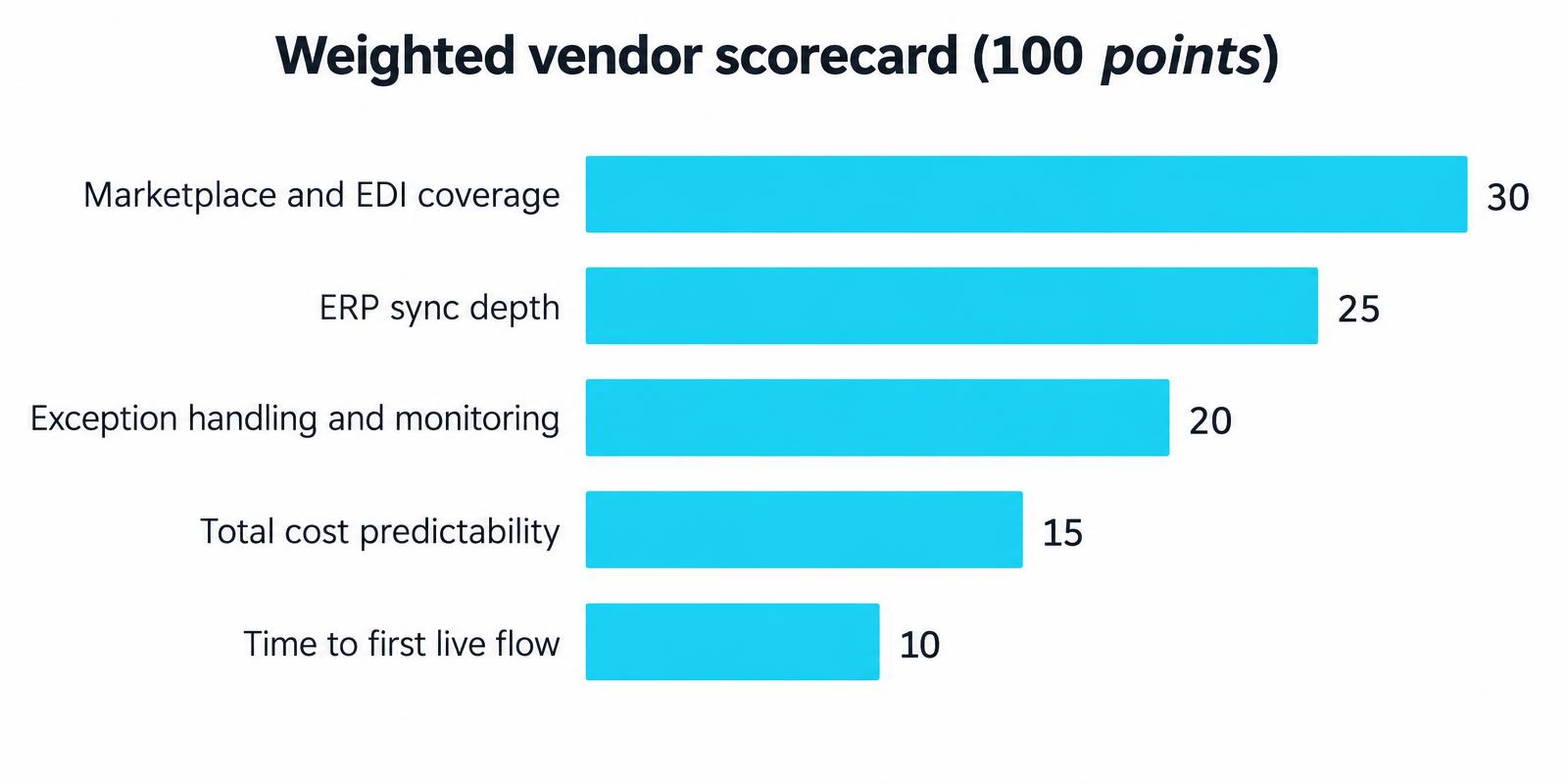
- Weight a 100-point scorecard toward marketplace and EDI coverage (30) and exception handling (20), not happy-path demos.
- Ask vendors to run failure scenarios live: failed ASNs, routing guide violations, and settlement reconciliation, not happy-path orders.
- Choose a point solution when one stage causes most pain; choose a managed platform when exceptions span multiple stages.
Order-to-cash automation software should be evaluated stage by stage: order capture, fulfillment, invoicing, collections, cash application, and reporting. This guide gives you a per-stage checklist, a weighted scorecard that sums to 100, and the demo questions that expose whether a vendor actually covers your ERP, marketplaces, 3PLs, and EDI retailers, including where our own product falls short.
What does order-to-cash automation software actually automate end to end?
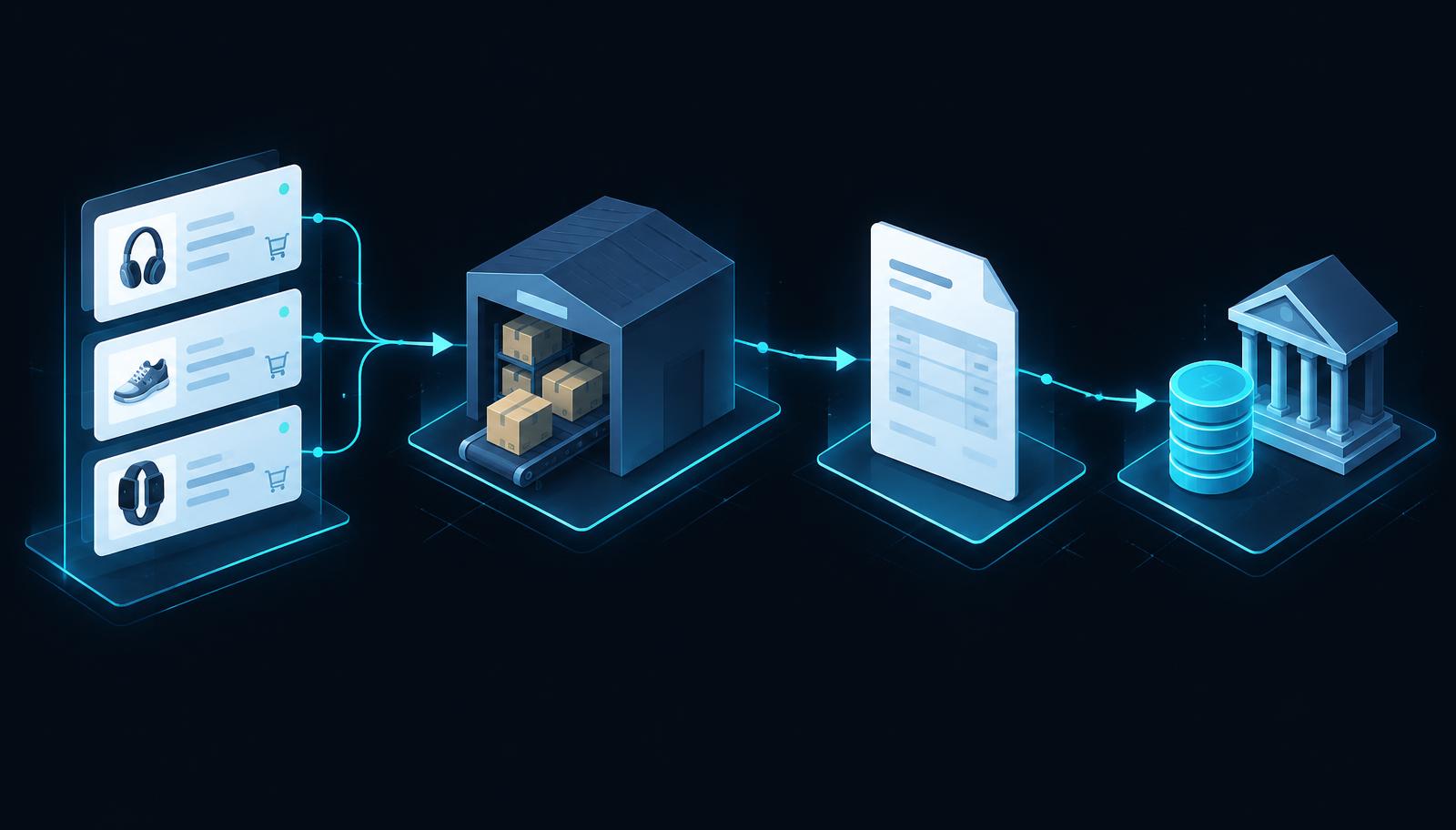
Order-to-cash automation covers every step from a marketplace order landing to cash hitting your bank account, reconciled in your ERP. The point is not just moving data between Shopify, Amazon, your 3PL, and NetSuite. It is eliminating the exception queues and spreadsheet ops that sit between those systems today.
The six stages, mapped to your stack
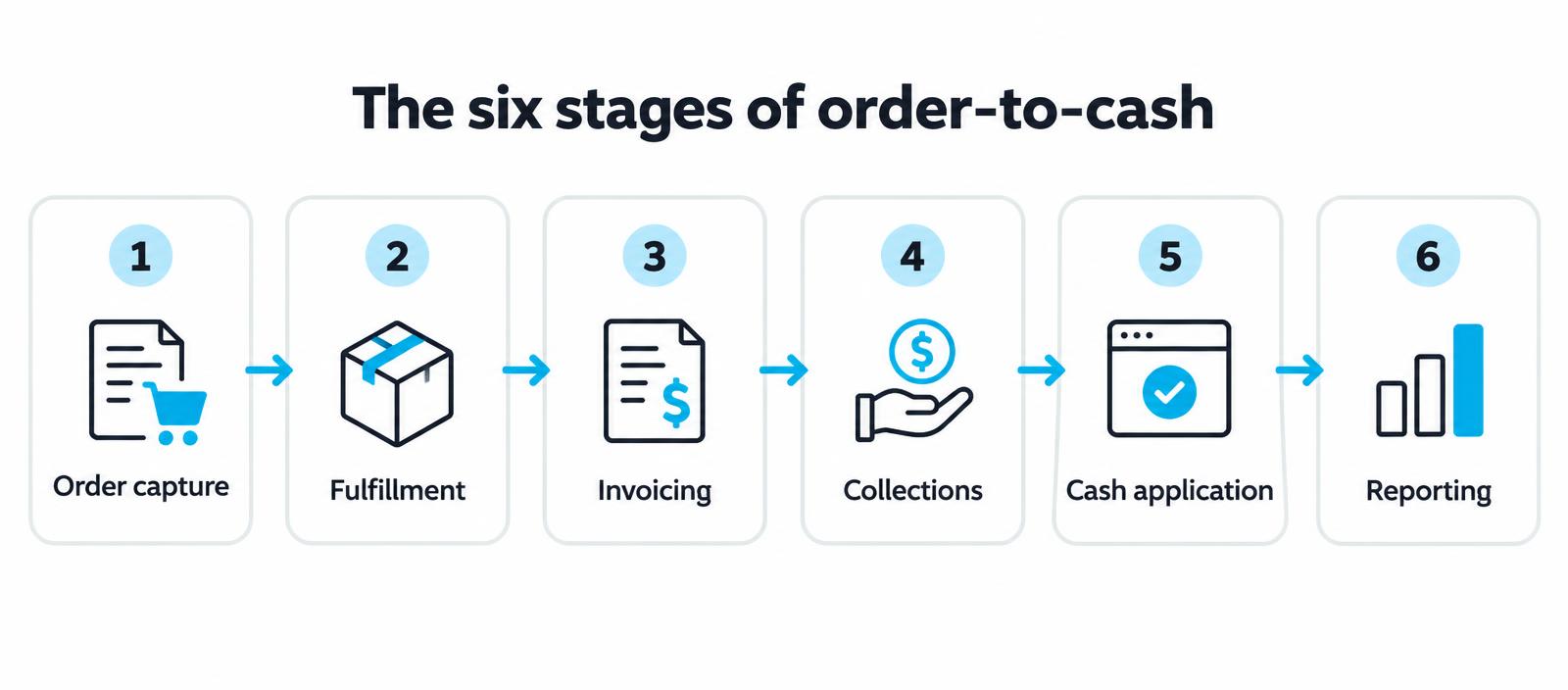
| Stage | What automation looks like in your stack |
|---|---|
| Order capture | Marketplace and EDI orders (POs) flow into the ERP without rekeying or channel-specific spreadsheets |
| Fulfillment | Inventory syncs across channels on a schedule tight enough to prevent oversells; ASNs and shipping confirmations go back to retailers automatically |
| Invoicing | Retailer invoices generate from fulfillment data, matching each routing guide so chargebacks don't pile up |
| Collections | Dunning and payment-status updates run off AR data instead of manual follow-up lists |
| Cash application | Marketplace settlement files reconcile line-by-line against orders, fees, and refunds in the ERP |
| Reporting | Order-to-cash metrics pull from one source rather than stitched-together exports |
Where manual work actually hides
The stages above are table stakes. The real cost lives in the gaps: field-by-field mapping projects that drift when a retailer updates its routing guide, settlement reconciliation done in Excel, inventory that goes stale between syncs. Vendor documentation shows how differently platforms handle this. Celigo documents prebuilt commerce connectors, while Boomi's documentation describes a broader connector library you assemble. The question to ask each vendor: who maintains the mapping when the retailer changes terms, and who watches the queue when a sync fails? At APIWORX, the ops team owns that monitoring; with tooling-first platforms, that burden stays with you.
Which order-to-cash stages deliver the fastest payback when automated first?
Start where exceptions cluster
Order capture and fulfillment come first. Marketplace order routing and 3PL sync are where oversells, stale inventory, and manual reconciliation pile up daily, so automation here removes recurring firefighting within weeks of go-live.
Invoicing and EDI compliance rank second. Routing guide violations and ASN or invoice errors turn directly into chargebacks, and each one is a measurable dollar loss. Cutting that error rate pays back fastest where retailer volume is highest.
Collections and cash application come third: they matter for order-to-cash automation, but a $20M-$200M brand usually has smaller exception volume there than in its marketplace and EDI queues.
Sequencing for brands on Shopify plus marketplaces plus an ERP
Automate storefront-to-ERP order flow first, then marketplace inventory sync, then retailer EDI documents, then settlement reconciliation. Each stage depends on clean data from the one before it, so this order avoids rework. Reporting comes last: once the earlier stages stop drifting, the numbers finally reconcile without spreadsheet ops, and dashboards built on top of them stay trustworthy.
How should you evaluate integration depth with your ERP, ecommerce, and payment systems?
Integration depth decides whether order-to-cash automation actually clears your exception queues or just moves them. Test it against the systems you already run: Shopify or BigCommerce, Amazon and Walmart marketplaces, 3PLs, and NetSuite, Brightpearl, or Sage.
Prebuilt vs custom mapping: what to verify
Ask for the connector list in writing, then ask what "prebuilt" means: shipped field mappings, transaction objects, and test environments, or a template your team fills in. For EDI, verify the vendor handles retailer-specific quirks, because routing guide violations turn into chargebacks. Walmart's own supplier documentation details compliance requirements for POs, ASNs, and invoices that suppliers must meet or absorb penalties against (Walmart supplier compliance). Confirm error handling and retry logic: what happens when a 3PL rejects an ASN, an order fails mid-mapping, or inventory syncs stale and you oversell a marketplace listing? The right answer is automatic retries with alerting thresholds, not a queue someone clears by hand.
Who owns the connector after go-live
APIs change, ERPs update, retailers rewrite routing guides. Ask who patches the connector when Shopify changes a webhook or NetSuite ships a release: your team, the vendor's ops team, or nobody. APIWORX runs a managed model where the vendor's team builds, monitors, and owns connectors on flat-fee pricing, so maintenance sits with them. Celigo, Boomi, and Workato typically expect more customer-side ownership, which is a legitimate trade-off only if you have the staff to carry it.
What questions should you ask vendors during an order-to-cash automation demo?
A demo that only shows a happy-path order flowing from Shopify into NetSuite tells you nothing. Bring your own failure scenarios and make the vendor run them live.
Questions that expose thin connectors
- "Show an 850 coming in from a retailer with a non-standard map. Who fixes the field-by-field mapping, and how long does that take?"
- "Run an order that fails at the 3PL. What does the exception queue look like, who gets alerted, and can I reprocess without a spreadsheet?"
- "Show me an ASN and invoice for a routing guide with a compliance violation. How do you flag it before the chargeback lands?"
- "Walk through Amazon settlement reconciliation. How do fees, refunds, and reserve amounts match back to orders in my ERP?"
- "What happens when inventory drifts between my ERP and a marketplace? Show the oversell guardrail."
Questions about operations and support model
- "When a flow breaks at 2am during peak, who fixes it: your team or mine?"
- "What is monitored proactively, and do I find out from your alert or from a Walmart seller performance notice?"
- "How are version upgrades to connectors handled, and what breaks?"
Vendors like Celigo, SPS Commerce, Boomi, and Workato will answer these differently, and the differences reveal whether you are buying software or an operating outcome. APIWORX runs the managed model: its ops team owns the connectors, monitoring, and exception handling on flat-fee pricing, so the honest answer to "who fixes it at 2am" is "we do." The trade-off is less in-house control: if your team wants to edit flows directly, a platform like Celigo or Workato gives you that, at the cost of owning the firefighting yourself.
How do you build a weighted scorecard to compare order-to-cash automation software?
The scorecard
Weight five criteria to 100 points: marketplace and EDI coverage (30), ERP sync depth (25), exception handling and monitoring (20), total cost predictability (15), and time to first live flow (10). Weighting coverage and exceptions highest reflects where your hours actually go: chargebacks, ASNs, and the exception queue, not the happy-path order.
Scoring the managed iPaaS category honestly
Apply the same rubric to every vendor. Celigo, Boomi, and Workato score well on ERP sync depth, since each maintains prebuilt connectors for NetSuite and Sage, whose order and inventory APIs are well documented (NetSuite SuiteApp documentation). SPS Commerce wins the EDI coverage criterion outright but covers less of the rest of order-to-cash. APIWORX scores strongest on exception handling and flat-fee cost predictability, and its ops team owns outcomes rather than handing you a console. Where APIWORX falls short honestly: it lacks the breadth of prebuilt connectors the larger platforms carry, so a niche marketplace or unusual ERP version may require a custom build rather than a same-day switch-on, and it offers less of the self-directed configurability that teams who want hands-on control expect. Score each vendor against your own channel mix before weighting the totals; a 30-point criterion that matches nothing you sell is worth zero.
When is point-solution automation better than a full order-to-cash platform?
If one stage causes most of your pain, a point solution wins. A brand with clean Shopify-to-3PL flows but heavy retailer EDI volume can run EDI compliance through SPS Commerce and leave the rest alone. Same logic if the only recurring fire is Amazon or Walmart settlement reconciliation: a reconciliation tool is cheaper and faster to stand up than a platform spanning order capture through cash application.
Signals you only need a point solution
One channel or retailer generates the exceptions. Order volume is stable. Your ERP handles the rest of order-to-cash without manual rekeying. Nobody is rebuilding field mappings quarterly.
Signals you need the full chain
Exceptions appear at multiple stages: oversells, inventory drift, ASN failures, and unmatched payments. Fixes in one stage keep surfacing problems in another. At that point, a managed model like APIWORX, where the ops team builds, monitors, and owns connectors on flat-fee pricing, beats stitching tools together. The tradeoff: you give up direct control of mappings, so verify change-request turnaround before signing.
What implementation and data-migration risks should buyers plan for?
Four risks dominate order-to-cash rollouts: field mapping drift between your ERP and marketplaces, historical reconciliation gaps that leave open invoices unmatched, inventory sync errors during cutover, and EDI partners requiring re-testing after any document change.
Cutover risks that cause oversells
Inventory sync is the riskiest moment. If counts go stale during the switch from your current process, Amazon and Walmart listings keep selling against phantom stock and you eat cancellations and account-health hits. Run the new sync in parallel for at least a week, keep the old counts authoritative until the new feed proves fresh, and set a hard oversell alert threshold before you flip channels.
A 30-60-90 rollout plan
Days 1-30: map one channel end to end (usually Shopify to ERP) and freeze field mappings in a documented schema. Days 31-60: cut over inventory sync and order capture, then migrate open invoices with a reconciliation bridge so nothing ages unapplied. Days 61-90: add marketplaces, 3PLs, and EDI documents, re-testing each trading partner before its routing guide deadlines hit. Ask every vendor to staff against this sequence before signing.
FAQ
How much does order-to-cash automation software cost for a mid-market brand?
Pricing varies by model. Tooling-first platforms like Celigo, Boomi, and Workato typically price on subscription tiers that scale with connectors and usage, plus internal staff time to build and maintain flows. Managed providers like APIWORX charge flat fees that include building, monitoring, and owning the connectors. Ask vendors to quote against your full channel mix.
Can order-to-cash automation handle retailer EDI requirements like ASNs and routing guides?
It depends on the vendor. Routing guide violations on POs, ASNs, and invoices convert directly into chargebacks, and Walmart's supplier documentation spells out the compliance requirements. In a demo, ask the vendor to show an ASN and invoice against a routing guide with a deliberate violation and explain how it gets flagged before the chargeback lands. SPS Commerce leads on EDI coverage specifically.
Do I need to replace my ERP to automate order-to-cash?
No. The software should sit on top of the ERP you already run, whether that is NetSuite, Brightpearl, or Sage, and sync orders, inventory, and settlements into it. The evaluation question is depth: does the vendor ship prebuilt field mappings and transaction objects for your ERP version, or a template your team fills in? Also confirm who patches the connector when your ERP ships a release.
How long does a typical order-to-cash automation implementation take?
Plan on a 30-60-90 day rollout. Days 1-30: map one channel end to end, usually Shopify to your ERP, and freeze field mappings in a documented schema. Days 31-60: cut over inventory sync and order capture, migrating open invoices with a reconciliation bridge. Days 61-90: add marketplaces, 3PLs, and EDI documents, re-testing each trading partner. Ask every vendor to staff against this sequence before signing.
What's the difference between order-to-cash automation and an iPaaS?
An iPaaS is a general-purpose platform for connecting applications; order-to-cash automation is the operating outcome built on one. Celigo, Boomi, and Workato give you connectors and a console, but your team assembles flows, watches queues, and owns firefighting. A managed order-to-cash provider runs the whole chain, from marketplace order capture through settlement reconciliation, with the vendor's ops team monitoring exceptions.
See the APIWORX platform in action
Tell us about your systems and we'll build a tailored automation plan within 1 business day.
Talk to an expert