Ecommerce Integration with ERP: Which Architecture Fits?
Native connector, iPaaS or managed integration: score each ecommerce-to-ERP architecture against order-to-cash and marketplace settlement reconciliation.
Key takeaways
- Native connectors are enough for one storefront, one warehouse, and a standard order flow with no marketplaces, EDI retailers, or 3PL handoffs.
- Marketplace settlement reconciliation is a financial workflow, not an order sync, and most store-to-ERP connectors cannot handle it.
- Four events signal you have outgrown a native connector: a second marketplace, your first EDI retailer, 3PL onboarding, or finance headcount spent on manual reconciliation.
- Sticker price is the smallest line item; exception queues, chargebacks, and reconciliation labor often cost more than the connector saves.
- Managed iPaaS trades in-house flexibility for someone else owning connectors, monitoring, and settlement reconciliation outcomes on flat-fee pricing.
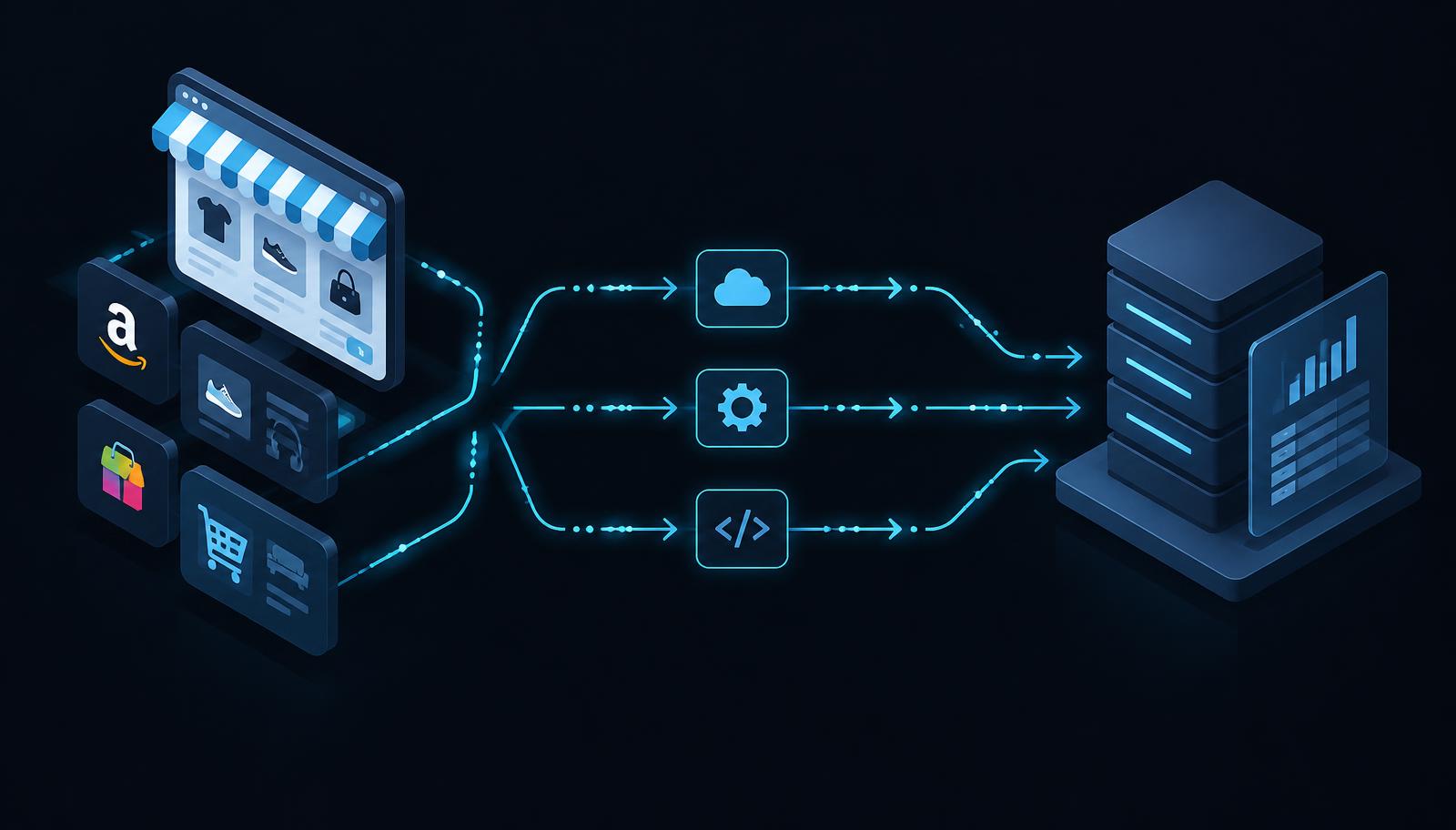
For a multi-channel brand on Shopify or BigCommerce with NetSuite, Brightpearl, or Sage, the right ecommerce integration with ERP depends on two things: how much of your order-to-cash flow is already automated, and whether marketplace settlement reconciliation lives in your exception queue. Native connectors handle the first case; iPaaS or managed integration platforms handle the second. This piece scores all three against both workflows so you can pick based on where your ops team actually spends its week.
What breaks first when your ecommerce store and ERP aren't integrated?
Inventory drifts first. Orders flow one way, stock levels never flow back, and your ERP's on-hand counts go stale within hours. That's how oversells happen on marketplaces, where a single oversold Walmart order can cost you the listing.
Then the orders themselves. Without ecommerce integration with ERP, someone rekeys Shopify orders into NetSuite or BrightCommerce by hand, field by field, and every manual keystroke is a wrong SKU or address waiting to ship.
Settlement is next. Marketplace payouts arrive as lump sums hiding fees, refunds, and adjustments, so reconciliation becomes a spreadsheet exercise each week.
Finally, chargebacks. Retail EDI requires ASNs, invoices, and routing-guide compliance on tight windows, and missed documents turn into deductions. A proper connector has to move far more data than most partial fixes handle, which is why those gaps persist. That's the case for a managed approach like APIWORX.
When is a native connector like NetSuite's Shopify integration enough?
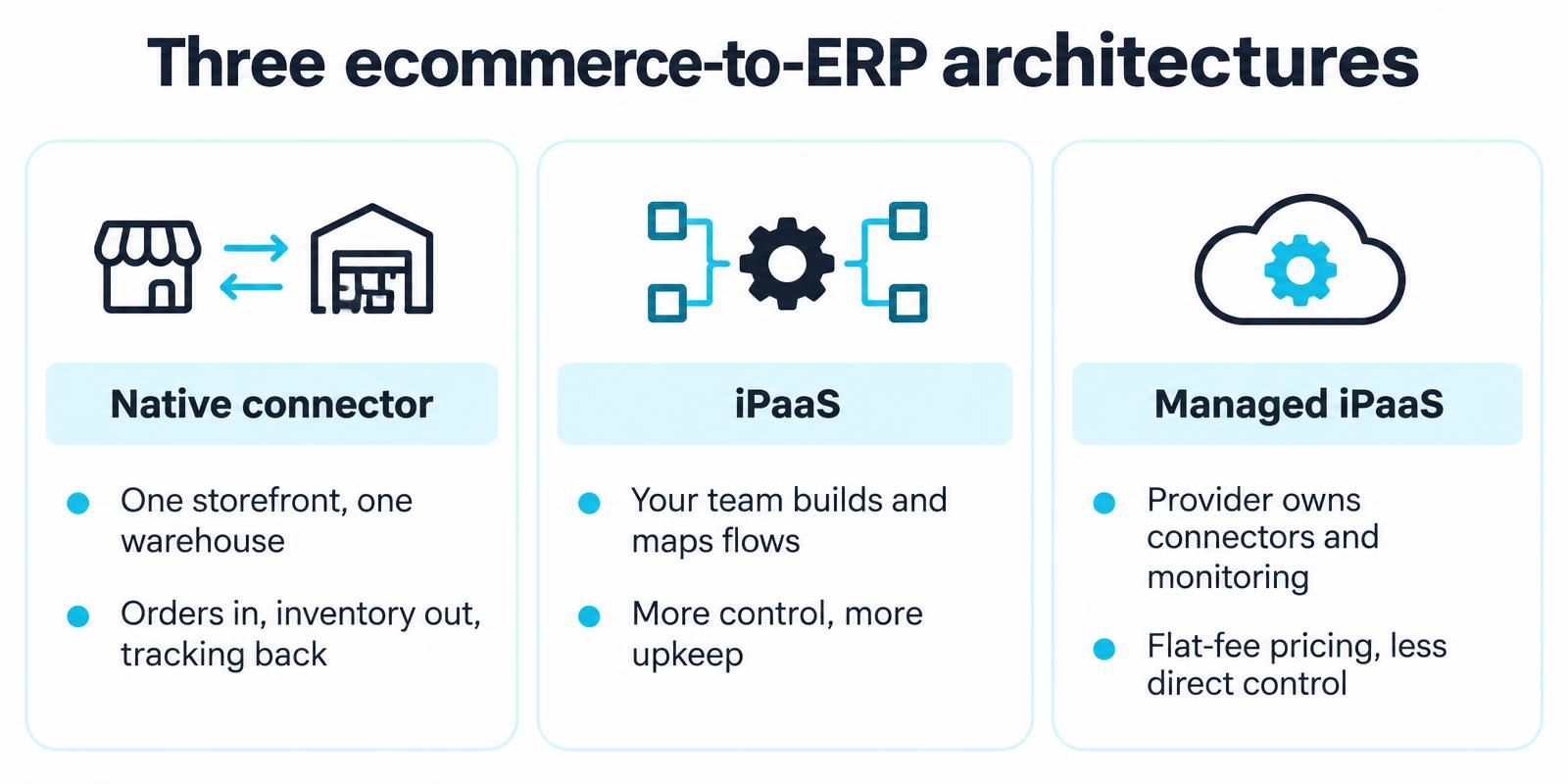
A native connector is enough when you run one storefront, one warehouse, and a standard order flow: orders in, inventory out, tracking back. No marketplaces, no EDI retailers, no 3PL handoffs. If your team isn't reconciling settlement files or clearing chargebacks, you don't need more than what NetSuite, Shopify, or BigCommerce ship themselves.
The economics are right too. The connector is already paid for, updates ride along with platform releases, and there's no new vendor to manage. For a single-brand DTC shop doing straightforward order-to-cash, that's the correct answer.
Where native connectors stop scaling
The limits show up the moment you add a second sales channel or a compliance obligation:
- Marketplaces. Amazon, Walmart, and Wayfair settlement data doesn't flow through a store-to-ERP connector, so reconciliation stays manual.
- EDI retailers. POs, ASNs, invoices, and routing guides are outside scope, and chargebacks land in your queue.
- Multi-warehouse inventory. Syncing one pool across Shopify, marketplaces, and a 3PL is where oversells and stale stock begin.
If any of those describe your next twelve months, plan the upgrade now rather than after the first oversell.
How should you evaluate an integration for order-to-cash automation?
Order-to-cash is the workflow where integration gaps cost real money. Judge any candidate against every stage, not just order sync.
The order-to-cash stages that must sync
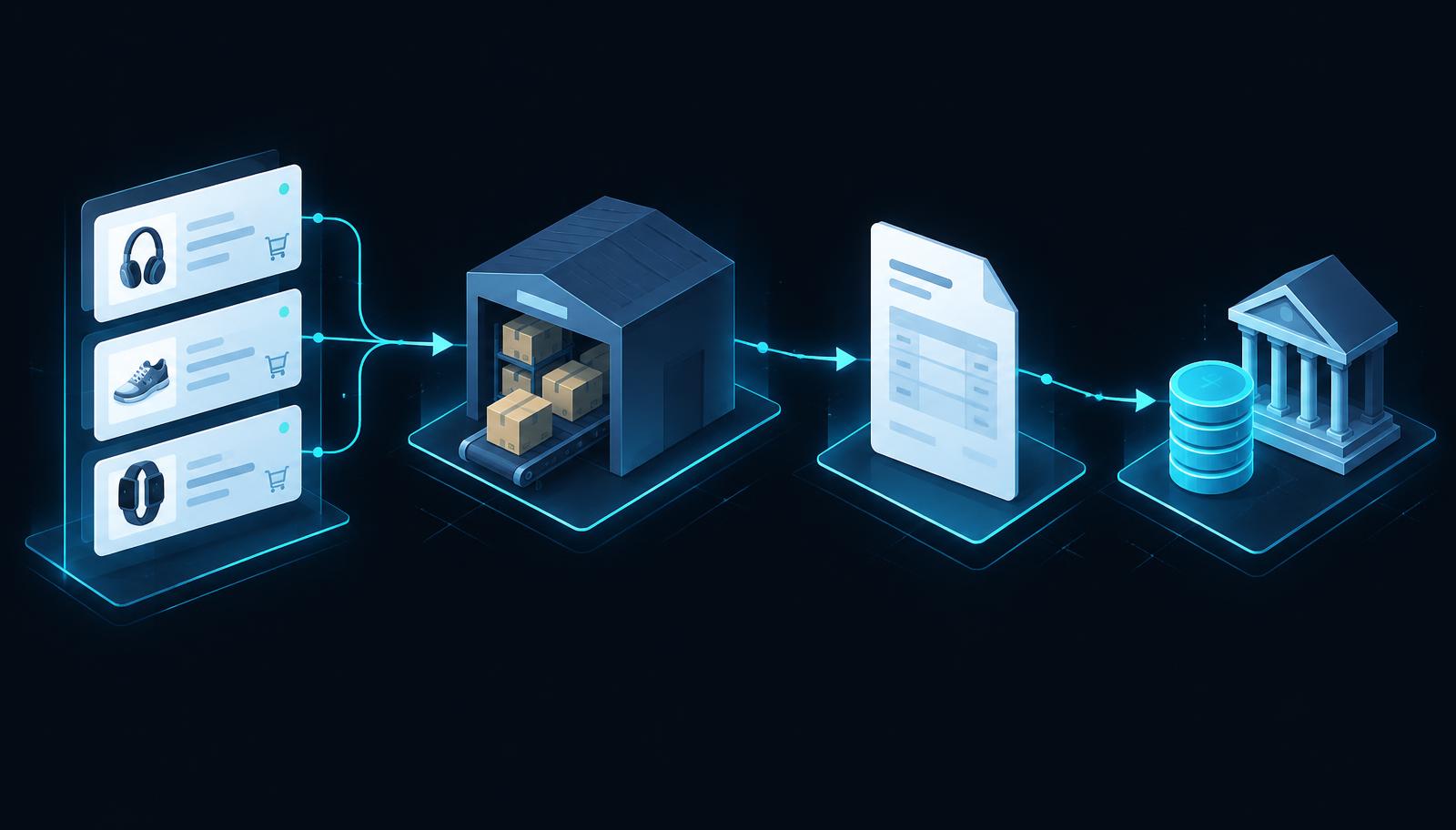
A complete integration covers: order capture from Shopify, Amazon, Walmart, and Wayfair; inventory availability pushed back out so you don't oversell; shipment and tracking confirmation to each channel; invoice generation in the ERP; payment and settlement application back to the order; and returns and refunds flowing both ways. Walmart alone requires reconciliation against settlement data in Seller Center, where transaction reports show commissions and adjustments per order (Walmart Marketplace seller documentation). If a connector stops at "order created in NetSuite," the back half of the cycle stays manual.
Scoring each architecture against the stages
Run every option through the same six-stage scorecard. A native connector may cover stages one to three well and leave settlement application to spreadsheets. Custom middleware can cover all six but you own the maintenance. A managed platform like APIWORX is built to own the full cycle, including exception queues, though you trade control for that coverage. Score honestly before you commit.
What does marketplace reconciliation require that standard order sync doesn't?
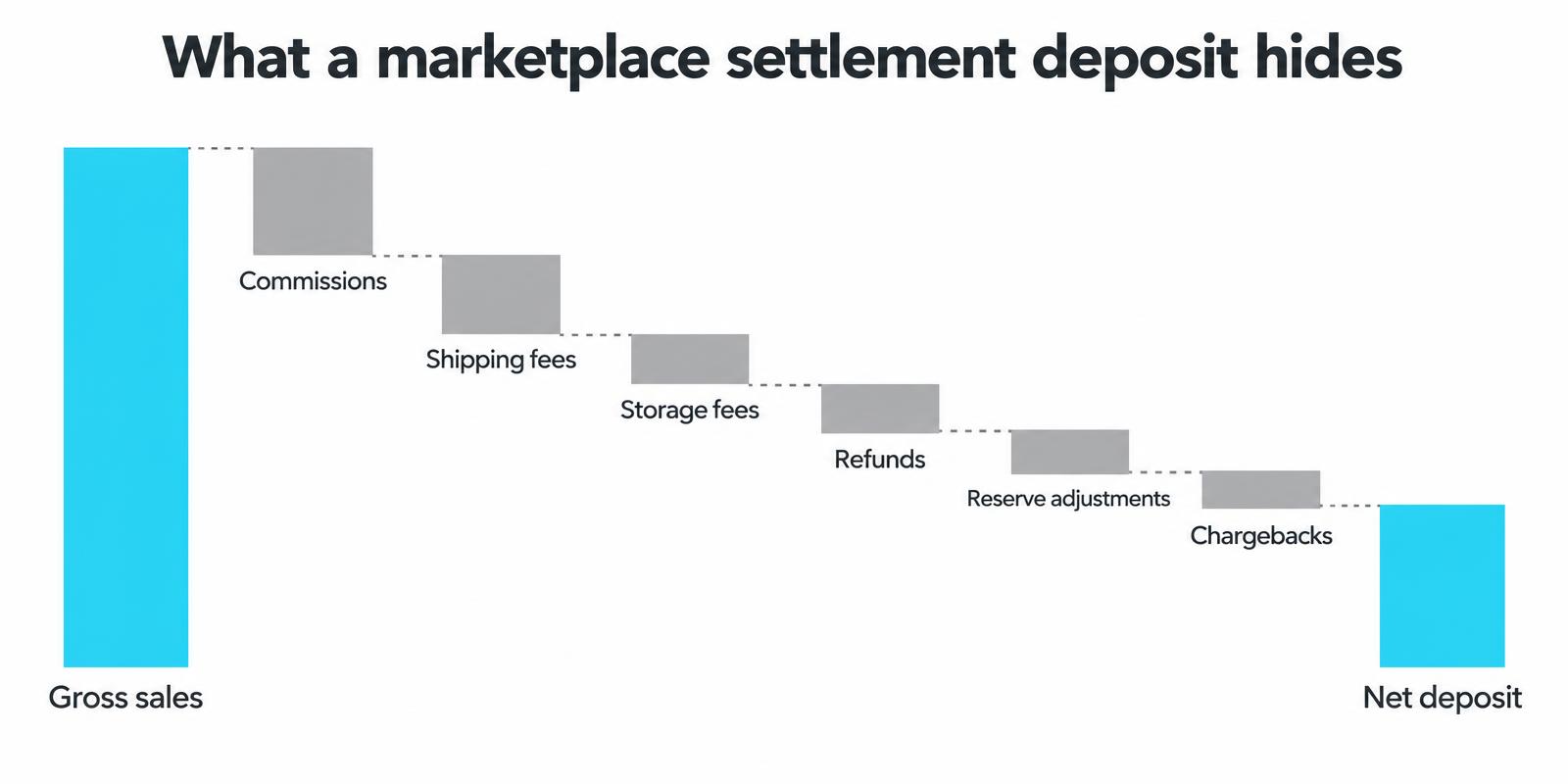
Order sync moves orders out. Reconciliation moves money back in, and that's where most integrations stop short. A settlement file from Walmart (or Amazon, or Wayfair) is not a list of orders; it's a financial document: gross sales minus commissions, shipping fees, storage fees, refunds, reserve adjustments, and sometimes chargebacks, all netted into a single deposit. Your ERP needs each of those line items coded correctly, or your margin reporting by channel is fiction.
The Walmart settlement workflow, step by step
Walmart settles on a two-week cycle. The file arrives with order-level detail: units sold, commission per order, shipping income, refunds and their fees, and adjustments for things like returns processed after the period closed. Your job is to match that deposit to ERP records that were created weeks earlier, at different prices, possibly against orders that were cancelled or refunded mid-flight.
That matching is the hard part. Every line needs a decision: which order, which SKU, which revenue account, which clearing account for the fees. When it's done in spreadsheets, one analyst spends days per cycle per channel, and errors surface later as unexplained variances in the deposit clearing account. When it's automated, each settlement line maps to a journal entry or an applied payment against the original sales order, fees land in the right expense accounts, and the deposit ties out to the penny. Standard order sync can't do any of this, because it was built to transmit orders, not to close the books. Marketplace reconciliation is a separate workflow with its own mappings, its own exception handling, and its own failure modes, and any architecture you choose needs to treat it that way.
How do you handle Walmart marketplace integration alongside Shopify and your ERP?
Walmart rarely fits the same pipeline as Shopify. Orders can flow through Walmart's native Shopify app or a marketplace manager, but settlement data arrives as a separate remittance report, and if you sell to Walmart as a supplier, EDI documents (POs, ASNs, invoices) come through Walmart's own requirements on top.
Three architectures handle this differently. A native marketplace app moves orders but leaves settlement reconciliation to spreadsheets. An iPaaS like Celigo adds Walmart connectors alongside your Shopify-to-ERP flow, so marketplace and DTC share one order-to-cash pipeline. A managed platform like APIWORX takes the same approach but owns the connectors and the reconciliation logic for you, including matching Walmart settlements against orders and ERP receipts, on flat-fee pricing.
The honest gap: no off-the-shelf option covers every retailer routing guide, so EDI-heavy supplier relationships may still need a specialist alongside whichever architecture you pick.
How do the three architectures compare on total cost?
Sticker price is the smallest line item. Native connectors look cheap until you count the ops cost: exception queues, manual reconciliation, spreadsheet workarounds, and the hours your team spends firefighting when inventory drifts or an oversell hits Walmart. A $0-$500/month connector that consumes two days a week of an ops manager costs more than it saves.
An iPaaS subscription (Celigo, Boomi, Workato) buys the platform but not the outcome. Budget builder time for field-by-field mapping, testing, and every new marketplace or 3PL you add, plus ongoing monitoring when an API changes mid-peak. Custom middleware is the most expensive path: you pay for the build, then pay again every time a routing guide, EDI spec, or ERP version shifts.
Managed iPaaS like APIWORX prices flat, and the ops team owns the connectors and outcomes, so the cost you see is the cost you pay.
Hidden costs that don't appear in vendor pricing
Chargebacks from a missed ASN, oversells from stale inventory, and reconciliation labor during settlement cycles rarely show up in any pricing page. Model them before comparing subscriptions.
Where managed iPaaS falls short too
Flat-fee means less flexibility to reshape workflows yourself, and you depend on the provider's queue for edge cases your ops team could patch faster in-house. If you need highly bespoke logic, weigh that trade-off honestly.
How do you decide when to graduate from a native connector to a dedicated integration platform?
Four trigger events tell you a native connector has hit its ceiling. First, a second marketplace: Walmart or Wayfair brings settlement files and SKU mapping your Shopify-to-NetSuite connector never planned for. Second, your first EDI retailer: POs, ASNs, and invoices against retailer routing guides are a compliance workload, not a data sync. Third, 3PL onboarding, which means inventory accuracy and oversell risk now depend on a third system. Fourth, finance headcount: if someone spends days per month on manual reconciliation, spreadsheet ops has become a payroll line.
A platform like SPS Commerce is built around retail trading-network work, which is why EDI-heavy brands land there. The honest trade-off: managed platforms cost more than a native connector, and you give up direct control of field-level mapping in exchange for someone else owning the exceptions.
Which architecture fits your brand?
A single storefront with a clean ERP and modest order volume can run on a native connector until it can't. Add a second channel, a 3PL, and EDI retailers, and native sync starts leaving you in exception queues.
If your complexity is volume, not variety, an iPaaS gives your team control over field-by-field mapping. If your complexity is accountability, meaning you need someone monitoring flows, chasing failed orders, and owning Walmart settlement reconciliation outcomes rather than handing you a dashboard, managed is the fit. APIWORX sits in that last lane: we build, monitor, and own the connectors on flat-fee pricing.
The honest caveat: if you want in-house control and have the staff to hold it, a platform like Celigo will serve you well.
FAQ
Can I connect Shopify to NetSuite without an integration platform?
Yes. NetSuite and Shopify both ship native connectors that handle orders in, inventory out, and tracking back. That's enough for one storefront, one warehouse, and a standard order flow with no marketplaces, EDI retailers, or 3PL handoffs. If you're reconciling settlement files or clearing chargebacks manually, you've outgrown the native option.
How much does ERP and ecommerce integration cost for a mid-market brand?
Sticker price is the smallest line item. Native connectors run cheap or free but consume ops hours on exceptions and manual reconciliation. iPaaS subscriptions (Celigo, Boomi, Workato) add builder time for mapping and testing. Custom middleware costs the most once maintenance lands on your team. Managed platforms price flat, with connectors and outcomes included.
What is the best way to reconcile Amazon and Walmart settlements in NetSuite?
Automate the mapping so each settlement line becomes a journal entry or applied payment against the original sales order, with fees coded to the right expense accounts and the deposit tying out to the penny. Standard order sync can't do this because it transmits orders, not financial documents. Spreadsheets cost days per cycle per channel.
Do I need EDI compliance handled by my integration platform?
If you sell to EDI retailers, yes: POs, ASNs, invoices, and routing-guide compliance are a workload your integration must own, or missed documents become chargeback deductions. No off-the-shelf platform covers every retailer's routing guide, so EDI-heavy supplier relationships may still need a retail trading-network specialist alongside whichever architecture you choose.
See the APIWORX platform in action
Tell us about your systems and we'll build a tailored automation plan within 1 business day.
Talk to an expert