
A unified operational data layer built from real integration activity.
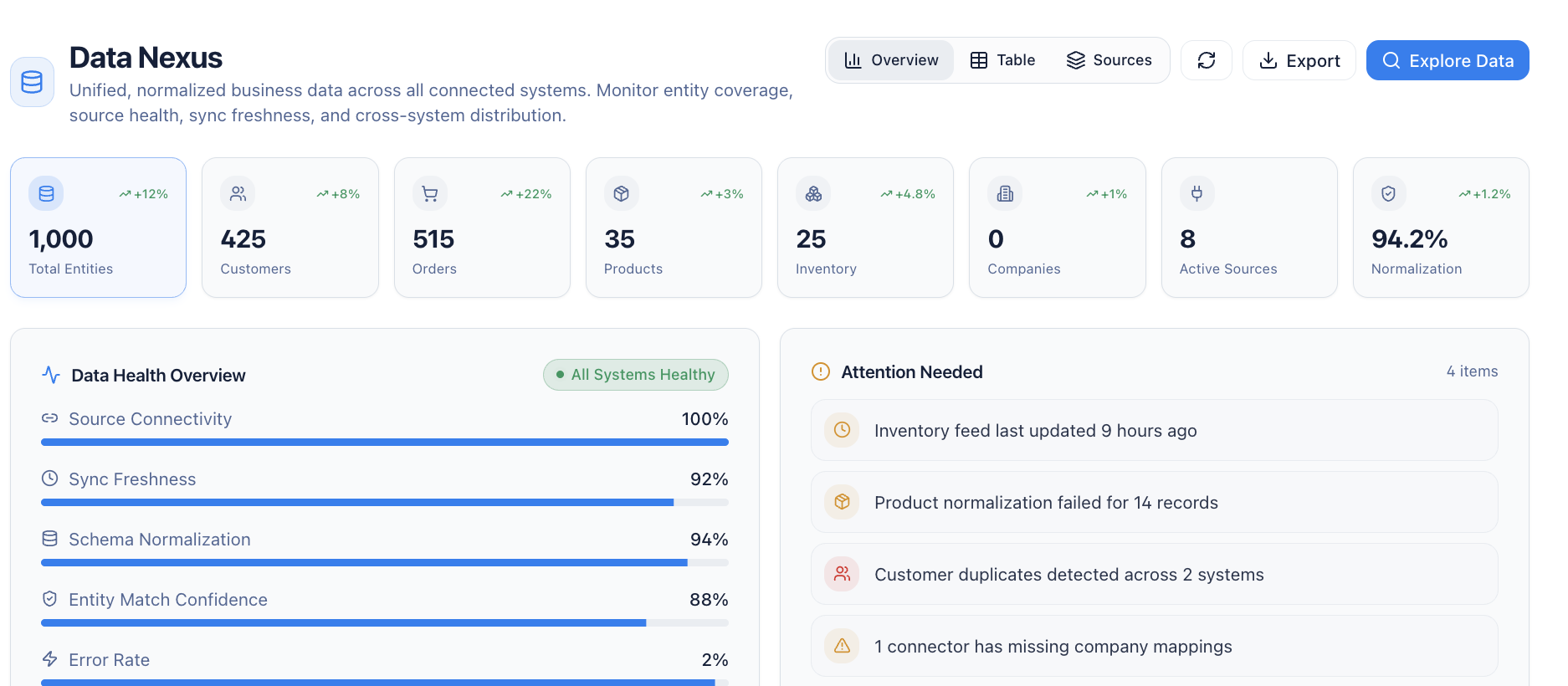
Warehouses, ERPs, ecommerce tools, and finance platforms all describe the business differently. apiworx.data creates an operational entity model from real integration activity, so teams can reconcile, reason, and act on what is actually happening now.
 Open live demo
Unified entities built from live integration activity provide more operational value than disconnected exports and delayed warehouse snapshots.
Why teams end up firefighting this
Historical analytics layers help with reporting, but they rarely explain live operational movement. Operators still need to know which order failed, which inventory state drifted, which customer record is canonical, or which payment never matched. That requires a governed operational model, not just a warehouse snapshot.
How the workflow runs in production
Each stage is mapped, monitored, and tied back to the business records teams actually care about.
What improves when the workflow is controlled
Where teams usually lose time
These are the common failure patterns that trigger spreadsheet work, support noise, and downstream fire drills.
Open live demo
APIWORX connects exceptions back to the exact execution stage, affected records, and system responses so remediation starts with evidence instead of guesswork.
Related paths through the platform
Use-case pages should connect back to the broader platform story, not sit as isolated leaf pages.
Questions operators ask before they commit
How is apiworx.data different from a data warehouse?
apiworx.data is designed around live operational entities and integration movement, not just historical analytics storage. It is meant to support reconciliation and action, not only reporting.
Talk to an architectWhat kinds of records can be unified?
Orders, customers, products, inventory, invoices, payments, shipments, and related operational entities can be normalized into a shared model.
Talk to an architectDoes the unified layer retain source lineage?
Yes. Preserving source-system identifiers and relationship context is central to making the unified model trustworthy and operationally useful.
Talk to an architect