
Customer synchronization that eliminates fragmented identities.
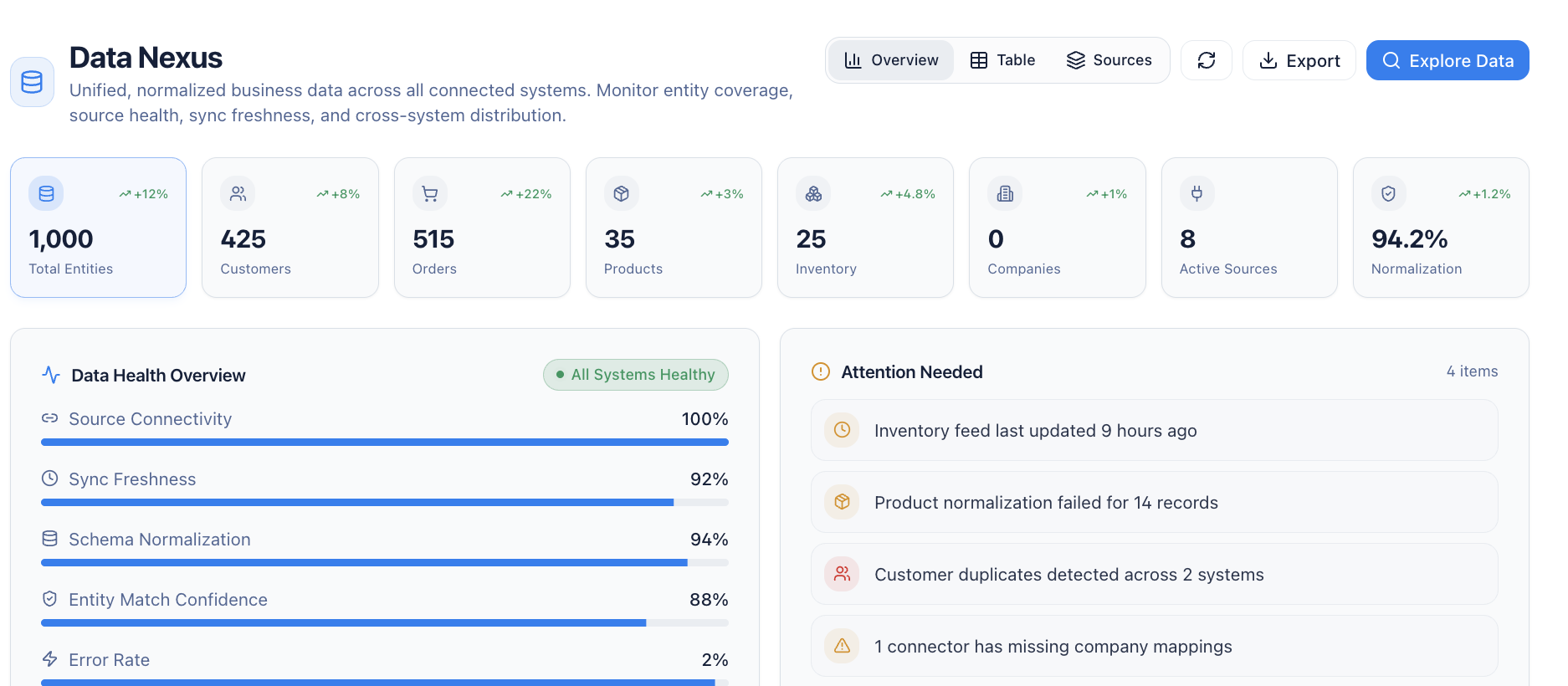
Customer data fractures quietly: duplicate accounts, mismatched addresses, different tax profiles, incomplete company hierarchies, and missing billing context. APIWORX moves customer updates reliably while apiworx.data gives teams a single operational record.
 Open live demo
Unified customer entities make support, finance, and commerce teams work from the same operational truth.
Why teams end up firefighting this
A customer can exist as a buyer in ecommerce, an account in CRM, a billing contact in ERP, and a company record in support tools. Without synchronization, teams operate on conflicting addresses, payment terms, tax IDs, and contact hierarchies.
How the workflow runs in production
Each stage is mapped, monitored, and tied back to the business records teams actually care about.
What stays connected
What improves when the workflow is controlled
Where teams usually lose time
These are the common failure patterns that trigger spreadsheet work, support noise, and downstream fire drills.
Open live demo
APIWORX connects exceptions back to the exact execution stage, affected records, and system responses so remediation starts with evidence instead of guesswork.
Related paths through the platform
Use-case pages should connect back to the broader platform story, not sit as isolated leaf pages.
Questions operators ask before they commit
Can APIWORX help with duplicate customer records?
Yes. It can route customer events through matching and normalization logic so duplicates are reduced and surfaced when manual review is needed.
Talk to an architectDoes this work for B2B account structures too?
Yes. Company, contact, address, and billing relationships can be synchronized across systems as part of the same governed workflow.
Talk to an architectWhat role does apiworx.data play here?
apiworx.data gives teams a unified customer entity and reconciliation context so they can understand how records relate across systems.
Talk to an architect