Don't Vibe Code Your Revenue Plumbing: 10 Reasons to Keep AI-Generated Code Out of Your Core Channel Integrations
Vibe coding is great for prototypes and risky for the systems that move your orders, inventory, and money. Ten reasons to keep it out of your core channel integrations.
By Charlie Alsmiller, Founder, APIWORX
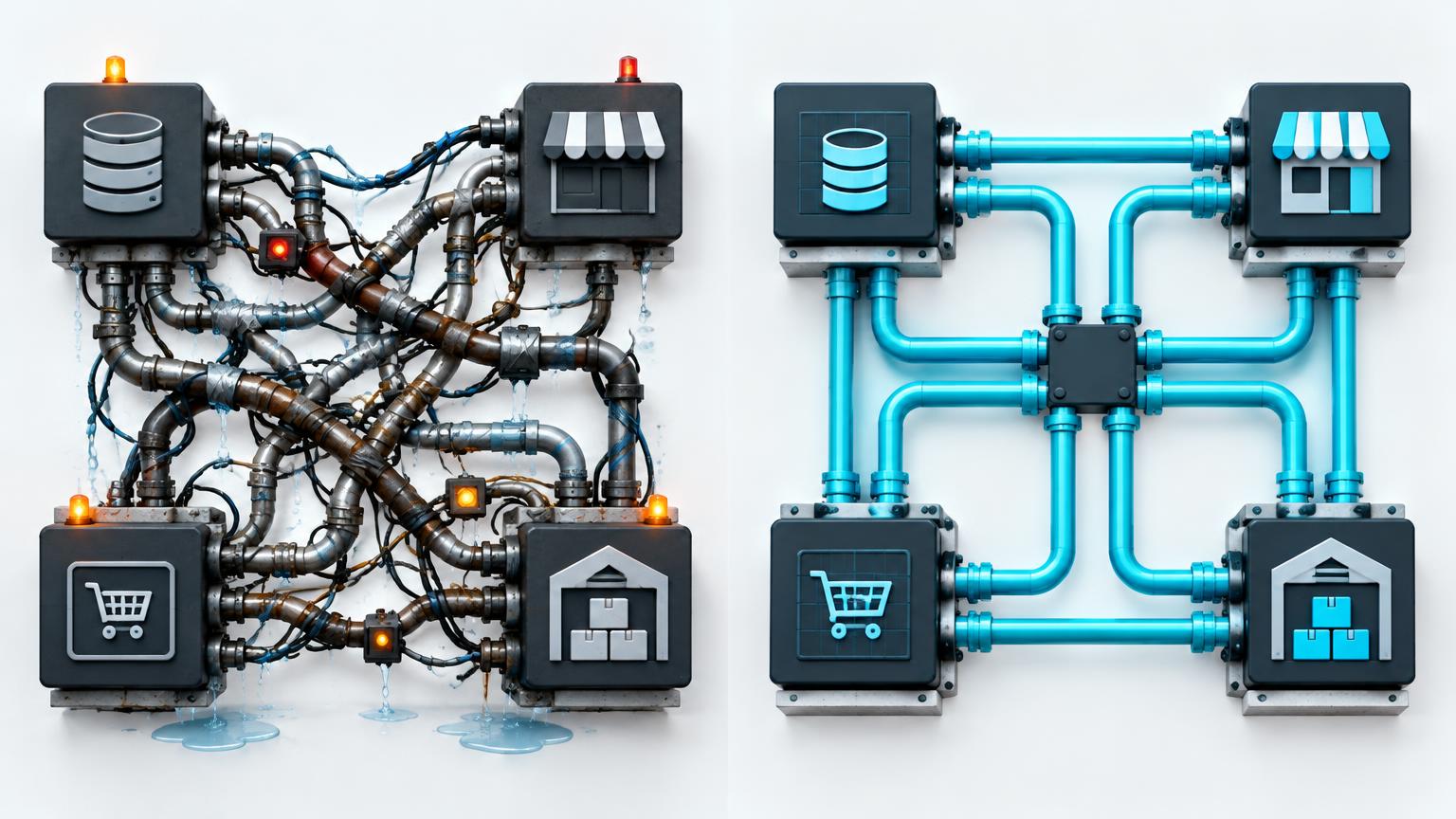
Vibe coding your channel integrations is the fastest way to build something you'll pay to rebuild. The term, coined by Andrej Karpathy in early 2025, means building software by prompting an AI and accepting whatever it writes, without really reading the code.
For a quick internal tool, that's a gift. Describe what you want, watch it appear, ship it before lunch.
Your core channel management is a different animal. It's the plumbing between your ERP, your storefront, Amazon and the other marketplaces, your retail EDI partners, and your 3PL. Every order, inventory count, and invoice rides on it.
When that plumbing breaks, you don't get a polite bug report. You get oversells, chargebacks, suspended listings, and customers who don't come back. Here are the ten reasons we tell every brand to keep vibe coding away from it.
1. The demo works. Production doesn't.
An AI can build an order sync that handles your five test orders perfectly. Real order flow is not five test orders.
Production brings split shipments, partial cancellations, backorders, bundles and kits, multi-currency orders, addresses that won't validate, and a SKU someone renamed last Tuesday. Each edge case is rare on its own. Together, they show up every single day.
A vibe-coded integration handles the cases you thought to prompt for. The ones you didn't think of are exactly the ones that bite.
2. The ground never stops moving
Channel APIs are not static. Marketplaces, ecommerce platforms, and ERPs version their APIs, retire endpoints, change authentication, and add required fields, usually with a hard deadline attached. Anyone who lived through Amazon's move from MWS to SP-API knows the drill.
An integration isn't a project you finish. It's a subscription to someone else's roadmap.
If nobody on your team understands how the code works, every deprecation notice becomes an emergency rewrite. And the AI session that wrote version one has no idea why it made the choices it did.
3. Inventory bugs turn into oversells, and oversells turn into suspensions
Inventory sync is where small bugs get expensive fast. Push stale counts and you sell product you don't have. Push zeros by mistake and your best-selling listing goes dark during your best-selling week.
Marketplaces track cancellation rates and late shipments, and they act on them. Too many seller-cancelled orders can cost you the Buy Box, your search ranking, or your selling privileges entirely.
Getting inventory right means handling buffers, safety stock, multiple warehouses, in-flight orders, and race conditions between channels. That logic has to be designed. It can't be guessed.
4. EDI doesn't care about your vibes
Retail EDI is unforgiving by design. The 850 purchase order, 855 acknowledgment, 856 ship notice, and 810 invoice each have strict formats and timing windows, with retailer-specific rules layered on top of the standard.
Get the ASN wrong and the retailer issues a chargeback. A bad SSCC-18 label, a carton count that doesn't match, a ship notice sent after the truck arrives: each one is a deduction, often discovered weeks later when the cause is hardest to trace.
A general-purpose AI knows what an 856 is. It doesn't know your retailer's routing guide, and it won't read the compliance manual for you.
5. Security is an afterthought
Integrations hold the keys to the kingdom: marketplace seller credentials, ERP admin access, customer addresses, and payment data. AI-generated code routinely hardcodes secrets, logs sensitive payloads, skips input validation, and pulls in packages nobody vetted.
The person prompting usually can't spot these problems, because spotting them is precisely the skill vibe coding skips.
When a retail partner or enterprise customer sends a security questionnaire asking about SOC 2, PCI, or data handling, "the AI wrote it" is not an answer that gets you through.
6. It only knows the happy path
Networks fail. APIs time out. Webhooks arrive twice, out of order, or not at all. Production integration code assumes all of that will happen and is built to recover.
Vibe-coded integrations usually assume everything works. The result is duplicate orders when a retry fires twice, lost orders when a call fails silently, and stale tracking updates that overwrite newer ones.
Idempotency keys, retry with backoff, dead-letter queues, replay, and daily reconciliation aren't glamorous. They're the difference between a hiccup and a weekend spent fixing your order table by hand.
7. You'll hear about failures from your customers first
Vibe-coded integrations rarely crash loudly. More often they just stop. A token expires, a scheduled job dies, a field mapping goes stale, and nothing tells anyone.
You find out when a customer emails asking where their order is, or when a marketplace's late-shipment clock has already run out.
Real integration operations need monitoring, alerting, run history, and a person accountable for watching it. You should know an order failed before your customer does.
8. Nobody understands the code, including the person who "wrote" it
The defining feature of vibe coding is that you don't read the code. That's fine right up until something breaks at 2 a.m. on Cyber Monday.
Now someone has to debug thousands of lines no human designed, with no documentation, inconsistent patterns, and logic that shifted every time someone re-prompted.
And if the one person who knows which prompts built it leaves the company, you don't have an integration anymore. You have a black box running your revenue.
9. It works at 50 orders a day. Black Friday isn't 50 orders a day.
Every channel enforces rate limits, and you feel them most exactly when you need throughput most. Code that makes one API call per order, per SKU, per update hits throttles the moment volume spikes.
Scaling takes batching, queuing, backoff, and prioritization, like sending shipment confirmations ahead of catalog updates when the pipe gets tight.
Those are architecture decisions. You can't prompt your way into them the night before peak season.
10. Cheap to build, expensive to own
The appeal of vibe coding is that version one costs almost nothing. But build cost was never the expensive part of an integration.
The real cost comes after launch: keeping up with API changes, chasing edge cases, cleaning up bad data, eating chargebacks and lost sales, and pulling your best people off growth work to babysit plumbing.
Add those up honestly and the "free" integration is usually the most expensive one you own.
So where does vibe coding fit?
None of this means AI doesn't belong in your stack. It's a genuinely useful tool. The question is where you point it.
The dividing line is simple: if a mistake can cost you money, inventory accuracy, customer trust, or a channel relationship, the code needs real engineering behind it. That means design, review, testing, monitoring, and someone accountable.
| Fine to vibe code | Keep it engineered |
|---|---|
| Fine to vibe codeA prototype to test a new channel idea | Keep it engineeredLive order sync to Amazon, Walmart, and Shopify |
| Fine to vibe codeA read-only internal sales dashboard | Keep it engineeredInventory pushes to every channel |
| Fine to vibe codeA one-time data cleanup script, reviewed before it runs | Keep it engineeredEDI 850, 856, and 810 flows with retail partners |
| Fine to vibe codePoking at a new API to see what comes back | Keep it engineeredPosting orders, invoices, and payments to your ERP |
Let your plumbing be boring
Your channel integrations are infrastructure, not a weekend project. The best ones are boring: reliable, monitored, kept current, and someone else's problem when a marketplace changes its API.
That's what APIWORX does. We build and manage the integrations between your ERP, ecommerce platforms, marketplaces, EDI trading partners, and 3PLs, and we keep them running as those platforms change underneath you.
Not sure where your current setup stands? Talk to us and we'll put together a free Integration Blueprint: a map of your systems, the gaps, and a prioritized plan to close them. Do it before you prompt your way into a production problem.