Multi-enterprise integration intelligence
    Shopify logoShopify
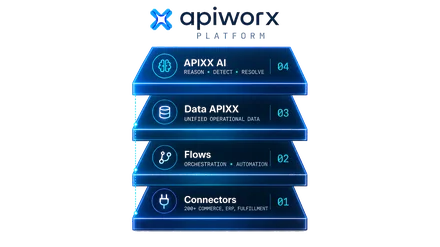
    APIWORX Platform — APIXX AI, Data APIXX, Flows, Connectors
    ERP logoERP
    Shopify ↔ ERP

    Shopify ERP Integration — Live in Days, Not Months

    Shopify ERP integration connects the world's most flexible commerce platform to the financial and operational backbone of your business. APIWORX is the integration partner of choice for hundreds of Shopify and Shopify Plus brands running NetSuite, SAP, Acumatica, Sage Intacct, Microsoft Dynamics 365 Business Central, and Brightpearl. Fully managed, no middleware for your team to maintain.

    Managed integration · 99.97% sync success · 30s mean root-cause

    Why Shopify ERP Integration Is Different

    Shopify is built for speed and merchant flexibility. ERPs are built for financial control and operational rigor. Connecting them well is a specialty — generic middleware almost always fails at one of the seams: B2B price lists, multi-location inventory, gift cards, marketplace orders, multi-subsidiary GL, or refund-to-credit-memo accounting. APIWORX has shipped every one of these patterns dozens of times.

    • Shopify Plus B2B — price lists, company accounts, payment terms, and tax exemptions flow from the ERP to Shopify and back
    • Multi-location inventory — Shopify locations stay accurate against ERP and WMS quantities in real time
    • Marketplace + Shopify — Amazon, Walmart, Wayfair, and Target+ orders consolidate into the ERP alongside Shopify orders
    • Shopify POS — brick-and-mortar transactions post to the ERP with the right channel, location, and tax handling
    • Headless Shopify — Hydrogen and custom storefronts integrate to the ERP through the same APIXX layer
    • Refunds and credit memos — Shopify refunds become ERP credit memos with proper revenue, COGS, and inventory adjustments

    ERPs We Connect to Shopify

    • Shopify ↔ NetSuite — see our [Shopify NetSuite flow](/flows/shopify-netsuite) for full detail
    • Shopify ↔ SAP — S/4HANA and Business One across orders, materials, and finance
    • Shopify ↔ Acumatica — orders, items, inventory, shipments, and financial posting
    • Shopify ↔ Sage Intacct — see our [Shopify Sage Intacct flow](/flows/shopify-sage-intacct)
    • Shopify ↔ Microsoft Dynamics 365 Business Central — orders, items, inventory, and finance
    • Shopify ↔ Brightpearl — see our [Shopify Brightpearl flow](/flows/shopify-brightpearl)
    • Shopify ↔ Epicor, Infor, and others — ask us; if it has an API, we have integrated it

    What Gets Synced

    • Orders — Shopify checkouts and draft orders post into the ERP as sales orders with correct line items, discounts, taxes, shipping, gift cards, and channel attribution
    • Inventory — ERP and WMS quantities push to Shopify in real time across every location, preventing oversells
    • Customers — bidirectional sync with deduplication, B2B account hierarchies, tax exemptions, and price list assignment
    • Products & Pricing — ERP items, variants, kits, matrix items, and price levels publish to Shopify and Shopify Plus B2B catalogs
    • Fulfillment — picks, packs, shipments, and tracking flow back to Shopify with accurate status and tracking links
    • Returns & Refunds — Shopify refunds become ERP credit memos with proper accounting impact
    • Financials — Shopify Payments, fees, refunds, and settlements map to the right GL accounts, classes, and subsidiaries

    How APIWORX Delivers Shopify ERP Integration

    1. 1
      Discovery — we map your Shopify configuration, ERP chart of accounts, custom records, item structure, fulfillment process, and edge cases. You sign off on a written design document before we build.
    2. 2
      Build — our Shopify- and ERP-certified team configures the connection on the APIXX platform with version control and audit logging.
    3. 3
      Test — end-to-end tests in an ERP sandbox and a Shopify development store, covering happy path, edge cases, and failure modes.
    4. 4
      Go Live — structured cutover with launch checklist, real-time transaction monitoring, and APIWORX on standby for the first two weeks.
    5. 5
      Ongoing Support — APIWORX continues to monitor, alert, and maintain the integration as Shopify, your ERP, and your business evolve.
    What usually breaks

    Where a Shopify and ERP workflow quietly fails.

    Most teams discover sync issues from a customer complaint, a chargeback, or a variance at month-end close — long after the cost is already booked. These are the failure modes APIWORX is engineered to absorb before they reach your operators.

    Silent payload drift

    When Shopify updates a field schema, untyped pipelines keep "succeeding" while writing the wrong values into ERP.

    Rate-limit cliffs

    Bursts during promos or end-of-month batches trip API quotas; orders queue, retries cascade, inventory drifts.

    Partial writes

    An order header posts, line items fail validation, no one sees it — until finance can't reconcile the settlement.

    Idempotency gaps

    Webhook redelivery duplicates orders, inflates inventory adjustments, and corrupts revenue reports.

    Mapping rot

    New SKUs, GL accounts, warehouses, or tax codes silently miss mappings and route to "Uncategorized" forever.

    Compliance exposure

    Retailer routing guides, EDI 856 timing, ASN accuracy — every missed window becomes a chargeback line.

    Workflow architecture

    How Shopify ↔ ERP actually runs in production.

    Every workflow is decomposed into discrete, observable stages — ingestion, transformation, validation, delivery — with persistence and replay between each step. No black boxes, no “hope the webhook worked.”

    Shopify
    Event source
    healthy
    Ingest & normalize
    Schema-typed
    healthy
    Validate & enrich
    Rules + APIXX AI
    healthy
    Deliver & confirm
    Idempotent write
    healthy
    ERP
    System of record
    healthy
    Throughput12,840 events / hr
    p95 latency418 ms
    Success rate (24h)99.97%
    Exception handling

    Failures don't disappear. They get worked.

    Every failed event lands in a typed exception queue with the payload, the failing field, the upstream actor, and a retryable verdict. Your team — or ours — works the queue, not the inbox.

    • Per-flow retry policies with exponential backoff + jitter
    • Automatic replay after schema or mapping fix
    • Hold-for-review on ambiguous writes (no silent corruption)
    • Full payload + diff stored for compliance and audit
    Exception queue
    last 24h
    • held
      evt_8af21c · Shopify → ERP
      Missing GL mapping for SKU 'GLOW-24-RFL'
      2m
    • resolved
      evt_8af1d3 · Shopify → ERP
      API 429 — retried 3× successfully
      11m
    • review
      evt_8aedf0 · ERP → Shopify
      Inventory delta exceeds threshold (412 units)
      47m
    • held
      evt_8ae9a1 · Shopify → ERP
      Tax code 'EU-VAT-RC' not in destination
      1h
    3 held · 1 in review · 24 auto-resolvedView all →
    Operational outcomes

    What changes for your operators in the first 30 days.

    99.97%
    Sync success rate
    Across Shopify ↔ ERP workflows, post-stabilization.
    − 86%
    Manual reconciliation
    Settlement, inventory, and order variance work, by hours/week.
    < 30s
    Mean root-cause time
    From failure to actionable diagnosis via APIXX AI.
    0
    Late-bound surprises
    No more discovering breakage at month-end.
    Managed accountability

    You don't own the pager. We do.

    APIWORX is not a tool you stand up and forget. We operate the integration with you — SP-API auth rotations, schema-change patches, retailer compliance updates, and 24×7 on-call coverage are part of the subscription.

    Named operations engineer
    SLA-backed response times
    Schema & API change tracking
    Quarterly architecture review
    Who owns what
    Responsibility You APIWORX
    Business rules & mappings
    API authentication & rotation
    Rate-limit handling & retries
    Monitoring, alerting, on-call
    Schema & connector upgrades
    Exception triage & replay
    Quarterly architecture review
    Enterprise architecture

    How Shopify ↔ ERP fits into your operational stack.

    Four layers. Each independently observable, independently replayable, and governed by the same Data APIXX entity model so finance, ops, and engineering see the same truth.

    Sources
    Shopify
    ERP
    Marketplaces
    EDI partners
    3PLs
    WMS
    Connectors (226+)
    Auth
    Pagination
    Rate-limit
    Webhooks
    Retries
    Backfill
    Data APIXX — unified entity model
    Order
    Inventory
    Shipment
    Invoice
    Customer
    Settlement
    Flows + APIXX AI diagnostics
    Routing
    Validation
    Reconciliation
    Exception queue
    Alerts
    Destinations
    ERP
    Finance
    OMS / WMS
    BI / warehouse
    Storefront
    CRM
    Industry complexity

    The complexity generic connectors won't admit to.

    Retail & marketplace compliance

    Routing guides, label specs, ASN timing, OTIF scorecards. We encode the rules and monitor adherence per partner.

    B2B distribution & EDI

    850/855/856/810 cycles, partner-specific 856 variants, multi-DC shipments, and pricing-by-customer logic.

    Multi-entity finance

    Currency, tax jurisdiction, intercompany, deferred revenue, and dimension mapping for clean close.

    Manufacturing & supply

    Work-order status, BOM revisions, supplier ASN, and inventory transfer accuracy across facilities.

    DTC & subscription

    Recurring billing, partial refunds, dunning, and gift-card liability — reconciled to the cent.

    3PL & fulfillment

    Multi-warehouse allocation, carrier rate shopping, exception-on-receive, and inventory drift detection.

    Shopify ↔ ERP — operational health
    live · 1m refresh
    Events / min
    214
    Errors / min
    0.4
    p95 latency
    418ms
    −24hnow
    13:42Auto-recovered from Shopify 429 burst
    13:31Schema change detected — destination field added
    12:58Mapping coverage alert resolved
    Observability

    You see what we see.

    Every event, payload, and decision is logged and queryable. Throughput, error rate, latency, and mapping coverage are exposed as first-class metrics — and routed to your Slack, Teams, or PagerDuty on the thresholds you set.

    • Per-flow SLOs with burn-rate alerts
    • Mapping coverage drift detection
    • Anomaly detection on inventory and settlement variance
    • Audit log export to Snowflake / BigQuery / S3
    APIXX AI diagnostics

    Root-cause in 30 seconds. Not 3 hours.

    APIXX AI watches every flow, payload, and exception. When something breaks, it correlates the failure against schema changes, rate-limit history, and prior incidents — and tells you exactly which mapping, field, or upstream actor caused it.

    APIXX AI · incident #4821
    resolved · 28s
    Failure
    47 Shopify order events failed validation writing to ERP.
    Root cause
    Shopify added field tax_inclusive on 2026-05-17. Mapping to ERP Line.TaxIncluded not configured.
    Recommended action
    Add mapping (1-click), replay 47 held events. Estimated impact: $18,420 in unblocked revenue.
    Operational readiness review

    Send us your stack. We'll send back the architecture.

    A 30-minute working session with an APIWORX operations engineer. You leave with a documented Shopify ↔ ERP architecture, the failure modes we'd absorb, and the SLOs we'd commit to. No pitch.

    Frequently Asked Questions

    Book a Free Shopify ERP Integration Assessment

    Tell us about your Shopify configuration, your ERP, and where you are feeling pain. We will come back with a written integration plan and timeline within 24 hours.

    See the platform behind trustworthy operations

    Tell us about your systems and challenges — our team will build a tailored automation plan within 24 hours.