Tell Us What You’re Connecting
Provide the systems, workflow and business requirements.
Commerce operations automation · Connect · Automate · Orchestrate · Flat-fee pricing
 Storefronts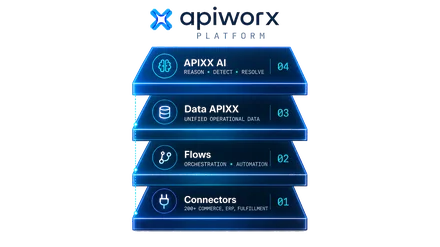
Ecommerce integration is the practice of connecting your storefronts and marketplaces to the operational systems behind them — ERP, WMS, 3PL, EDI, accounting — so orders, inventory, items, customers and fulfillment data stay accurate everywhere, in real time. APIWORX runs ecommerce integration as a fully managed service on the APIWORX platform for hundreds of mid-market and enterprise brands.
Brands running this stack with APIWORX
Managed integration · 99.97% sync success · 30s mean root-cause
How it works
Provide the systems, workflow and business requirements.
APIWORX recommends the integration architecture, mappings and implementation approach.
APIWORX implements the integration and provides ongoing monitoring and support as applicable.
A complete ecommerce integration is bidirectional and covers every system that touches an order from cart to GL.
Every storefront, marketplace and ERP has its own data model, its own quirks and its own API release cycle. The hard part of ecommerce integration is not the happy path — it is partial fulfillments, marketplace returns, kit explosions, multi-currency settlements and the next API deprecation that lands at 11pm on a Friday.
Evaluating vendors? Each comparison covers what the platform is genuinely best at, how pricing expands as volume grows, how much commerce logic ships out of the box, and who owns operations after go-live.
General-purpose integration platforms. Powerful and flexible, but commerce logic and day-two operations stay with your team.
Purpose-built for retail and DTC operations. The question is usually depth — ERP posting, EDI compliance and settlement reconciliation.
Built for software companies shipping integrations to their own customers. A different buyer than a brand connecting its own commerce stack.
Replication and finance data pipelines. Excellent for reporting and the ledger; operational order, inventory and settlement flows sit outside the design.
Fast, cheap and excellent for internal workflows. Best-effort delivery is the limitation once orders and inventory are involved.
Most teams discover sync issues from a customer complaint, a chargeback, or a variance at month-end close — long after the cost is already booked. These are the failure modes APIWORX is engineered to absorb before they reach your operators.
When Storefronts updates a field schema, untyped pipelines keep "succeeding" while writing the wrong values into ERP & Ops.
Bursts during promos or end-of-month batches trip API quotas; orders queue, retries cascade, inventory drifts.
An order header posts, line items fail validation, no one sees it — until finance can't reconcile the settlement.
Webhook redelivery duplicates orders, inflates inventory adjustments, and corrupts revenue reports.
New SKUs, GL accounts, warehouses, or tax codes silently miss mappings and route to "Uncategorized" forever.
Retailer routing guides, EDI 856 timing, ASN accuracy — every missed window becomes a chargeback line.
Every workflow is decomposed into discrete, observable stages — ingestion, transformation, validation, delivery — with persistence and replay between each step. No black boxes, no “hope the webhook worked.”
Every failed event lands in a typed exception queue with the payload, the failing field, the upstream actor, and a retryable verdict. Your team — or ours — works the queue, not the inbox.
APIWORX is not a tool you stand up and forget. We operate the integration with you — SP-API auth rotations, schema-change patches, retailer compliance updates, and 24×7 on-call coverage are part of the subscription.
| Responsibility | You | APIWORX |
|---|---|---|
| Business rules & mappings | ||
| API authentication & rotation | — | |
| Rate-limit handling & retries | — | |
| Monitoring, alerting, on-call | — | |
| Schema & connector upgrades | — | |
| Exception triage & replay | ||
| Quarterly architecture review | — |
Four layers. Each independently observable, independently replayable, and governed by the same apiworx.data entity model so finance, ops, and engineering see the same truth.
Routing guides, label specs, ASN timing, OTIF scorecards. We encode the rules and monitor adherence per partner.
850/855/856/810 cycles, partner-specific 856 variants, multi-DC shipments, and pricing-by-customer logic.
Currency, tax jurisdiction, intercompany, deferred revenue, and dimension mapping for clean close.
Work-order status, BOM revisions, supplier ASN, and inventory transfer accuracy across facilities.
Recurring billing, partial refunds, dunning, and gift-card liability — reconciled to the cent.
Multi-warehouse allocation, carrier rate shopping, exception-on-receive, and inventory drift detection.
Every event, payload, and decision is logged and queryable. Throughput, error rate, latency, and mapping coverage are exposed as first-class metrics — and routed to your Slack, Teams, or PagerDuty on the thresholds you set.
apiworx.ai watches every flow, payload, and exception. When something breaks, it correlates the failure against schema changes, rate-limit history, and prior incidents — and tells you exactly which mapping, field, or upstream actor caused it.
tax_inclusive on 2026-05-17. Mapping to ERP & Ops Line.TaxIncluded not configured.A 30-minute working session with an APIWORX operations engineer. You leave with a documented Storefronts ↔ ERP & Ops architecture, the failure modes we'd absorb, and the SLOs we'd commit to. No pitch.
Your integration plan
Tell us what systems you need connected. We’ll recommend the architecture, implementation approach, timeline and estimated price range.